

The Educated and the Unskilled Indians
Posted by admin on 2024-10-22 |
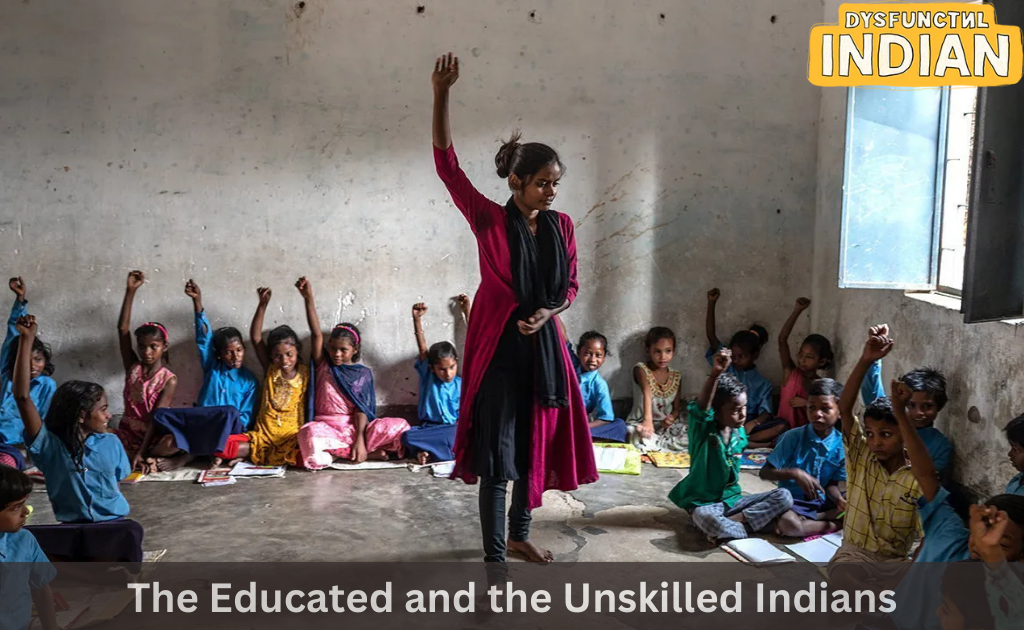
The value of a college degree has
long been considered a ticket to success. But as the world rapidly changes,
this conventional wisdom is being questioned. With soaring tuition fees, the
rise of online learning, and an evolving job market, are traditional degrees
really losing their value? For India, where higher education is often seen as
the key to economic mobility, this is a pressing question.
The Shifting Job Market
One of the most significant reasons
why traditional degrees are being re-evaluated is the shifting job market. In
the past, having a bachelor's degree was often enough to secure a stable,
well-paying job. However, today, companies are increasingly looking for skills
rather than credentials. A recent survey by NASSCOM revealed that nearly 40% of
India’s workforce will need reskilling in the next five years due to
technological disruptions like automation and artificial intelligence.
The Rise of Alternative Learning
Platforms
The rise of online education was
particularly visible during the COVID-19 pandemic, when schools and
universities had to shift online. A report by the Ministry of Education showed
that nearly 93% of Indian households had access to some form of online learning
during the lockdown. Platforms like Coursera, edX, and Khan Academy are
democratizing education by making high-quality courses available to anyone with
an internet connection. This shift to online education has led many to question
whether the traditional classroom model is still necessary, especially when
platforms like Coursera offer courses from top universities at a fraction of
the cost.
Cost and Return on Investment
One of the biggest criticisms of
traditional degrees is their cost. While the cost of higher education in India is
not as exorbitant as in countries like the U.S., it is still a significant
financial burden for many families. A report by the National Sample Survey
Office (NSSO) in India highlighted that education expenses have risen sharply
over the past decade. The average cost of a general degree in a private
institution can go up to ?50,000 per year, and for professional courses like
engineering or medicine, it’s much higher.
With these rising costs, the return
on investment for a degree is becoming a critical consideration. A 2019 report
by the India Skills Report found that only 47% of graduates in India were
employable. This mismatch between degrees and job market needs has led many to
question whether spending lakhs of rupees on a traditional degree is worth it
when many graduates remain unemployed or underemployed.
Take the example of engineering
graduates in India. According to a study by Aspiring Minds, 80% of Indian
engineers are not fit for employment in the knowledge economy. Many engineering
graduates are now forced to take jobs that are unrelated to their field or far
below their qualification level, simply to make ends meet. This oversupply of
graduates in certain fields, coupled with a lack of skills that the job market
demands, raises serious concerns about the effectiveness of traditional higher
education.
Changing Employer Perspectives
Another factor contributing to the
declining value of traditional degrees is the changing perspective of
employers. Companies like TCS, Infosys, and Wipro are now offering on-the-job
training programs that focus on skills over degrees. Many multinational
corporations have publicly stated that they no longer require applicants to
have a degree, but instead look for competencies and skills.
Elon Musk, the CEO of Tesla, has
famously said that you don’t need a college degree to work for his company.
Similarly, IBM and Google have reduced their reliance on formal education
credentials in favor of skills-based hiring. This shift is also becoming
evident in India, where companies are beginning to prioritize practical skills
over traditional academic qualifications.
A study by LinkedIn found that 69%
of professionals in India believe skills are more important than qualifications
in today's job market. Employers are increasingly using skill assessments and
practical tests to evaluate candidates rather than relying solely on their
educational background. This change in mindset is driving a transformation in
how education is perceived and consumed.
A Hybrid Model
As the world rapidly changes, it's
time to reassess the role of traditional degrees in higher education. For
India, where education has long been seen as a pathway to success, this shift
presents both challenges and opportunities. The key to navigating this new
landscape lies in embracing a more flexible, hybrid model of education—one that
values skills alongside formal qualifications.
New Education Policy (NEP) 2020 is
trying to address this very issue by introducing flexibility in higher
education. The NEP emphasizes interdisciplinary learning, skill development,
and vocational training, aiming to make education more relevant to the current
job market. It also encourages the integration of online courses with
traditional programs, creating a more flexible, skills-based learning
environment.
Only by taking such steps can we
prepare the next generation for the challenges of a rapidly evolving job
market.